
Beginners
Shibari for Beginners: Nerves First, Then Knots
Shibari for beginners in the right order. Where the radial nerve runs, shears in reach, which rope to buy, then the single column tie drilled on your own leg.
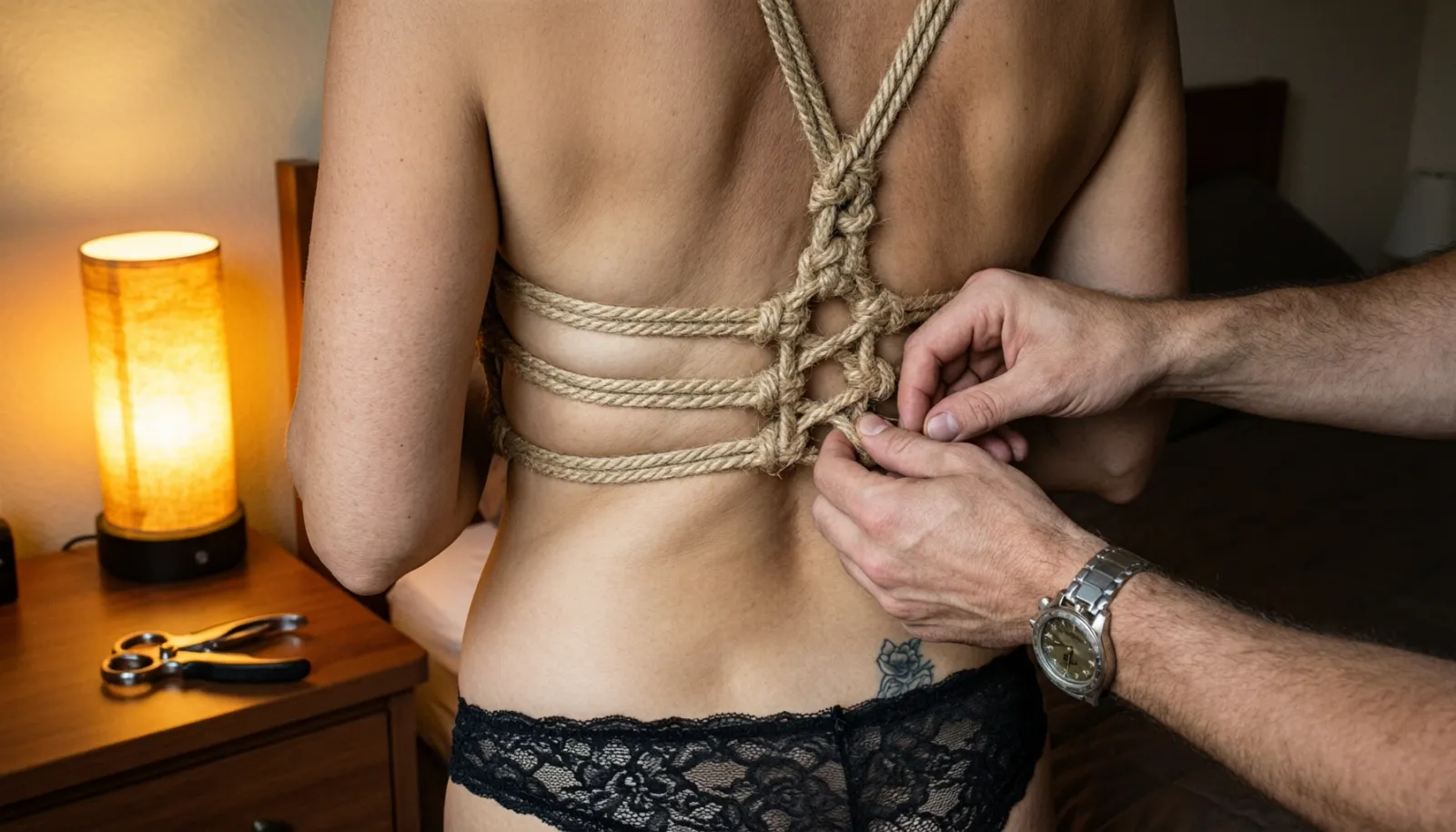
Shibari for beginners goes in one order, and it isn't the order most classes use. Learn where the radial nerve runs, put a pair of safety shears within arm's reach, buy two ropes, and tie a single column tie on your own leg until your hands know it without you. After that you tie a person, on the floor, for twenty minutes, and suspension stays off the menu this year. The talking half of rope, the negotiation and the pacing and the checking in, can be rehearsed in text with a rope-minded character on KinkSim long before anyone's wrist goes into a wrap.
Shibari basics: what the words mean
Shibari is the Japanese verb for tying. Kinbaku means tight binding. The western scene spent years arguing that one is the art and the other the sex, and there's no evidence the Japanese practitioners who built the form ever drew that line. Say either.
The person tying is the rigger, or the top. The person in the rope is the bottom, or the model. You'll read "rope bunny" all over the internet, but the term has been dropping out of use in studios for years, so say bottom at a jam. If you don't know which side you're on yet, the rigger and rope bunny pages describe each seat, and the bondage page covers the wider appetite that rope sits inside.
Fold a rope in half and the loop at the fold is the bight; the loose ends are the tails.
Nerve safety first, because rope injures nerves before anything else
Rope doesn't hurt people by cutting off blood. It hurts them by pressing on a nerve, and the nerve that takes it worst is the radial. A 2023 case series in the medical literature looked at ten people injured by Japanese rope bondage and found sixteen nerve injuries, with nine of the ten carrying radial damage. The index case was 6 mm jute, a 25 minute face-down suspension, and a wrist that took five months to lift again.
The radial nerve runs down the middle third of the upper arm, on the back and outer side, where it lies directly on the bone with nothing between it and a rope band. That's why box ties, the takate kote and its cousins with wraps around the upper arms, are the tie that sends people to the neurologist, and why they aren't a beginner tie. One page ranking for this search puts the radial nerve in the inner forearm. It isn't there.
The others worth knowing are the ulnar at the inner elbow, which numbs the pinky and half the ring finger, the median at the front of the wrist, which takes the thumb and first two fingers, and the common peroneal at the outside of the knee just below the joint, where a careless leg tie gives someone foot drop. The neck takes no rope, ever, decorative or otherwise.
Nerve trouble and circulation trouble feel different. Circulation goes slowly, spreads across the hand, changes the color, and comes back with a wiggle. A nerve goes suddenly, in one patch, one or two fingers, as pins and needles or a burning line or a small electric shock, and moving the hand doesn't clear it. If the bottom can't give a thumbs-up or bend the hand back at the wrist, the radial nerve is being compressed and the rope comes off now, not at the end of the scene. A tight fist tests the median, an OK sign tests fine control, and toes lifted toward the shin test the peroneal. Ask every few minutes and compare both sides. "You okay?" gets a yes from a bottom who is floating. "Show me a thumbs-up" gets data.
Nerve damage is also cumulative, so a tie that was fine a hundred times can drop a wrist on the hundred-and-first, and it can arrive with no warning at all. Wide flat bands instead of a single thin line, nothing across the outer upper arm, and a clock are the only defense you have.
The kit: shears, rope, and nothing from the garage
Buy the shears before the rope. Blunt-tip EMT shears, the serrated ones, cut jute cleanly and won't open skin if the bottom jerks. They live on your person or on the floor within reach of the free hand. A pair in a bag across the room is a pair you don't have. Cutting is the last resort.
Rope, checked against the studio shops in September 2026:
- Jute. Grippy, almost no stretch, holds a friction without a knot, and rough enough that some people love it and some people itch. It needs a wash, a stretch-dry, and some oil before it's pleasant.
- Cotton. Soft, cheap, and forgiving on skin. It also stretches, so your tension drifts, and it jams under load, so the knot you tied easily won't come undone easily. Fine for month one if jute makes you flinch.
- MFP, the polypropylene stuff sold as bondage rope. Strong, cheap, washable, and slippery, so nothing holds where you put it, and it burns skin when it runs. Good on a chair leg, bad on a person.
Paracord, clothesline, and the coil from the boat are out. The standard is 6 mm at 7.5 to 8 meters, and two or three of them covers everything you'll do for months, so buy the pair.
Shibari knots for beginners: the single column tie on your own leg
Every harness in shibari is column ties joined by frictions, and a column is anything you can wrap, a wrist, an ankle, a thigh, a bedpost. The version below is the plain two-wrap, two-hitch tie. The Somerville bowline is the one most jams and online schools will show you next, and it has a quirk worth knowing before it goes on a partner. Under real tension it's near impossible to untie, so you plan the order you'll take rope off in.
Sit down and cross one ankle over the opposite knee so the calf is in front of both hands, then:
- Fold the rope, hold the bight, and wrap twice around the lower calf above the ankle bone. Keep the wraps flat and side by side with no crossing, and leave two fingers of room underneath.
- Bring the bight over all four strands and tuck it under them, away from you and back.
- Make a loop with the running line, pass the bight through, and snug it. Do it a second time. The knot sits on the outside of the leg, off the bone.
- Pull the tails as hard as a struggling partner would. The wraps must not move. If they cinch, you've tied a slip knot, which is the one thing a column tie must never be.
Fifty repetitions, then fifty with your eyes shut. The leg is the right practice column because it's the width of a forearm, and if you get it wrong the only casualty is your own calf. Drilling on a leg you can free with one hand is also a different thing from tying yourself into something you can't get out of. It has its own page of self-bondage ideas, and none of it applies to a beginner with one rope.
Once the single column holds, the double column is the same tie with more slack around two wrists, and it is never a load-bearing tie. It does wrists together, wrists to a bedframe, or ankles together; the best bondage positions page shows where each leads. A ladder tie down a leg or arm comes next, which is column ties stacked, and after it a basic chest harness. The takate kote is not on this list.
Most classes spend too long on knots
The half hitch takes an afternoon. The Somerville bowline takes a week. The things that take a year are all in the hands and the eyes: keeping the same tension across a wrap so one strand doesn't take the load, running rope without dragging it across skin, feeding it from a coil so you never stop to untangle, and watching a hand for the first shade of pale while your mouth is still talking. A class that teaches six knots in two hours has taught six things you'll forget and skipped the one that keeps someone's wrist working.
If you get to choose, pick the workshop that ties one thing slowly and then makes both of you talk about how it felt. Anyone who has sat through a beginner rope class knows the knots take a week and the trust takes a year.
Tying a person for the first time
Talk before rope. Cover what's off the table, how long, what the bottom's body already does badly, an old shoulder, a carpal tunnel, low blood pressure, and what happens if they float and stop answering. Agree a safeword and a non-verbal signal too, a double squeeze or a dropped object, because a gag or a deep headspace takes words away first. Watches and rings come off. BDSM for beginners walks through this negotiation for any first scene; the rope version adds the nerve checks and a clock.
Thirty minutes is a sensible ceiling for a first floor scene, shorter with the arms raised or behind the back. Untie slowly and in reverse order, and treat the untying as part of the scene rather than the cleanup. Rope marks are normal and fade in hours. Pain that stays, numbness that stays, or a hand that won't lift is a doctor visit, and if the weakness is still there the next morning that visit is urgent. The kink roleplay safety and consent guide covers aftercare and drop, which rope produces as reliably as any impact scene.
Where to learn shibari next
Find a rope jam. They run weekly in most cities with a scene and they're the cheapest education there is. Never touch a bottom who is in someone else's rope, and take rope only from the communal box. Online, Shibari Study, The Duchy and Crash Restraint are where the scene sends beginners, and all three teach the single column tie above on video.
Text can't teach your hands, and it shouldn't pretend to. What it can rehearse is the half that classes skip, the negotiation and the pacing, describing a wrap so the person in it feels it, checking in without breaking the spell. That's what bondage roleplay with AI is for. The characters under the shibari tag on KinkSim are written by people who care about rope, and a creator can take over the chat live in Player Mode; the AI bondage page collects the wider set. Run a scene in text, then go tie your leg again.
Questions, answered
- What should a shibari beginner learn first?
- Where the radial nerve runs, before any knot. It sits on the outer back of the upper arm, halfway between shoulder and elbow, directly on the bone, and it is the nerve that rope injures most often. After that, the single column tie, drilled on your own calf until it holds under a hard pull without tightening. Suspension and the takate kote box tie come years later, not months.
- Which rope is best for shibari beginners, jute, cotton or MFP?
- Jute, 6 mm, 7.5 to 8 meters, two of them. It grips, barely stretches, and is what a class will hand you. Cotton is softer and cheaper but stretches and jams under load, which is fine for a first month if jute scratches. MFP is strong and washable but slippery, and it burns skin when it runs, so keep it for drilling on a chair leg.
- How do I practice shibari knots for beginners without a partner?
- Sit down, cross one ankle over the opposite knee, and tie the single column tie on your own calf. It is the width of a forearm, you can feel two fingers of clearance from the inside, and you can free it with one hand. Fifty repetitions, then fifty with your eyes shut. Chair legs and pool noodles work for frictions and harness shapes later on.
- How do I know if shibari rope is pressing on a nerve?
- Nerve trouble arrives suddenly, in one patch of a hand or foot, as pins and needles, burning, a small electric shock, or weakness. Circulation loss spreads slowly across the hand and changes its color. Ask for a thumbs-up and a hand bent back at the wrist for the radial nerve, a tight fist for the median, toes lifted toward the shin for the peroneal. Any failure means the rope comes off immediately.
- Can a beginner do shibari suspension?
- No. The best-documented rope injuries come from suspensions, including a 25 minute face-down suspension in 6 mm jute that left a bottom unable to lift her wrist for five months. Floor work for at least a year, taught in person, then partial suspension under an experienced rigger with a spotter, is the sequence the studios use, and there is no shortcut in a video.
- How many ropes do I need for shibari basics?
- Two or three, each 6 mm and 7.5 to 8 meters, all the same length. One rope does a single column tie, a double column, and a leg ladder. Two makes a basic chest harness. Ropes get joined mid-tie when you need more, so buying odd lengths to fit a specific body is a waste. Add a pair of blunt-tip safety shears before you add a fourth rope.
- What is the difference between shibari and kinbaku?
- Shibari is the Japanese verb for tying; kinbaku means tight binding. Western practitioners often use kinbaku for the sensual, connected form and shibari for the aesthetic one, but there is no evidence Japanese rope teachers ever drew that line, and both words describe the same rope on the same bodies. Say either. Rigger and bottom are the role words that matter more.
- What do I negotiate before tying someone for the first time?
- Limits, a time ceiling of about thirty minutes for a first floor scene, any old injuries or conditions such as a bad shoulder, carpal tunnel or low blood pressure, a safeword and a non-verbal signal for when words go, and what happens if the bottom drifts and stops answering. Jewelry and watches come off. Agree who checks in and how often, and that a nerve symptom ends the tie without discussion.